
Pad Flanges & Anchor Flanges: Uses, Specs & Standards
Not every flange-shaped plate on a piping system exists to bolt two things together. Pad flanges reinforce a vessel wall where material was cut away for a nozzle; anchor flanges lock a length of pipe in place against forces that would otherwise push it around. Here's how each works, and how to specify one correctly.
Pad flanges and anchor flanges are both look-alikes of a standard flange that solve entirely different problems — one reinforces a vessel wall where material was cut away for a nozzle, the other locks a length of pipe in place against forces that would otherwise push it around. They get confused with each other and with standard bolted flanges often enough that it's worth covering both in one place, side by side, with the specs that matter for each.
Pad Flanges
What Is a Pad Flange?
Cut an opening into a pressure vessel or storage tank wall, and you've removed material that was doing structural work — carrying hoop stress, resisting internal pressure. A pad flange, sometimes called a reinforcing pad or "repad," is a circular plate welded flush around that opening to put the lost strength back. It isn't a bolted connection component; the actual flanged joint sits on the nozzle itself. The pad's only job is structural — spreading load around the opening so the parent shell doesn't carry it alone.
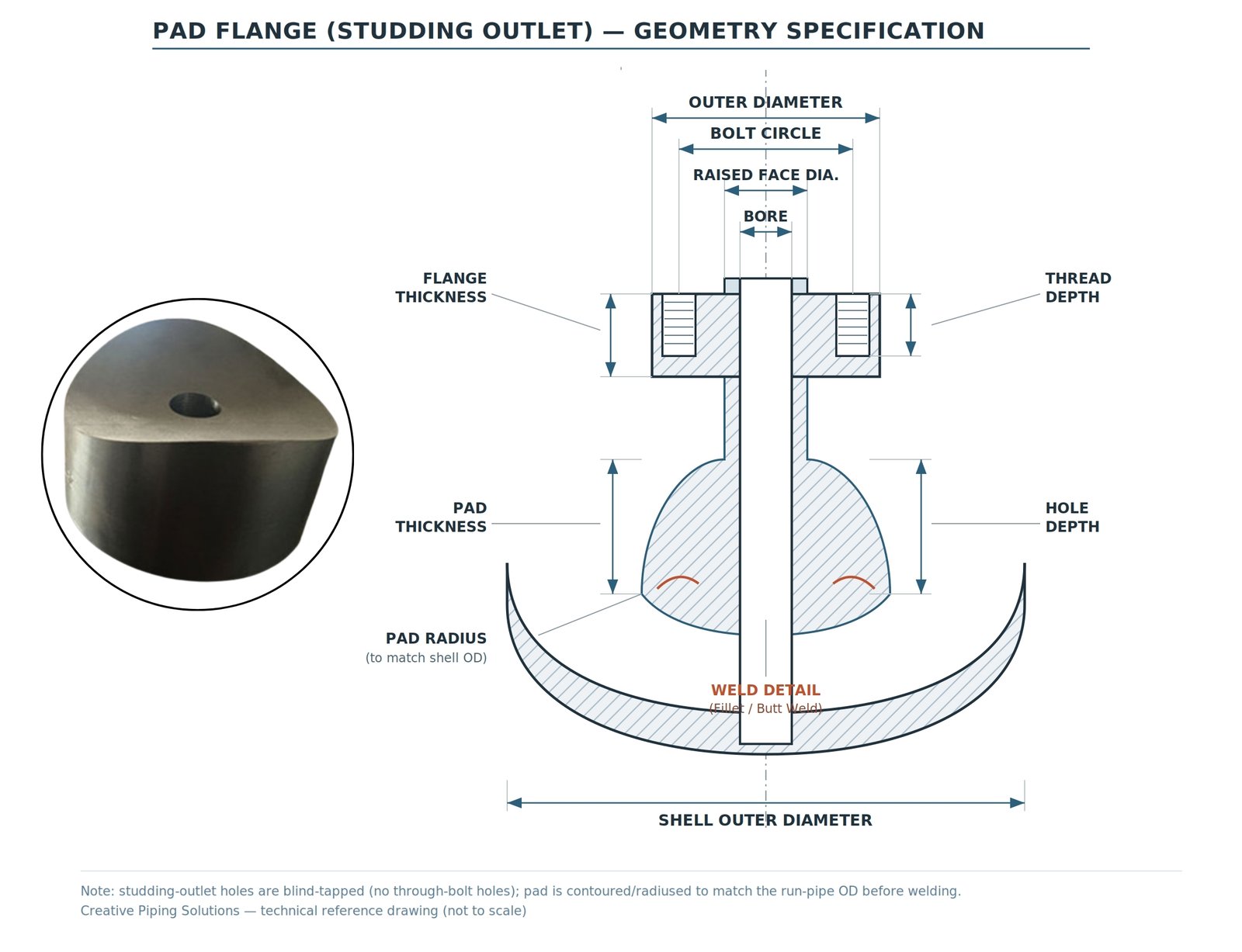
Most pressure vessel codes, ASME Section VIII among them, require a reinforcement calculation any time material is removed for an opening above a certain size. If the nozzle neck alone doesn't replace enough of that removed area, a pad makes up the difference.
Why Nozzle Reinforcement Matters
Every opening in a pressurized shell is a stress concentration point. Without adequate reinforcement, the metal around that opening carries disproportionately high stress, and over time — especially under cyclic pressure or thermal loading — that's where cracking starts. On any code-stamped vessel, a correctly sized pad isn't optional; it's a calculated requirement.
- Material
- Matched to the parent vessel or tank shell material — carbon steel, stainless steel, or alloy grade — so pad and shell weld and expand compatibly
- Thickness
- Set by the area-replacement calculation, not a fixed value — depends on opening diameter, shell thickness, and design pressure
- Standard
- ASME Section VIII Division 1 (UG-37 reinforcement rules), ASME B16.5 for the mating flange itself
- Applications
- Pressure vessels, storage tanks, heat exchangers, and any large-diameter pipe where a nozzle opening removes significant shell material
- Design Feature
- Many pads include a small tapped "telltale hole" on the outer edge, used to verify weld integrity during hydro testing
Pad Flange Installation & Welding Considerations
Pad flanges are welded around their full circumference to the parent shell, and weld quality here matters as much as the sizing calculation itself. Poor fit-up or incomplete penetration defeats the point of the reinforcement. The telltale hole is typically left open until after hydro testing — if pressure escapes through it, that signals a weld defect between pad and shell that needs repair before the vessel goes into service.
Anchor Flanges
What Is an Anchor Flange?
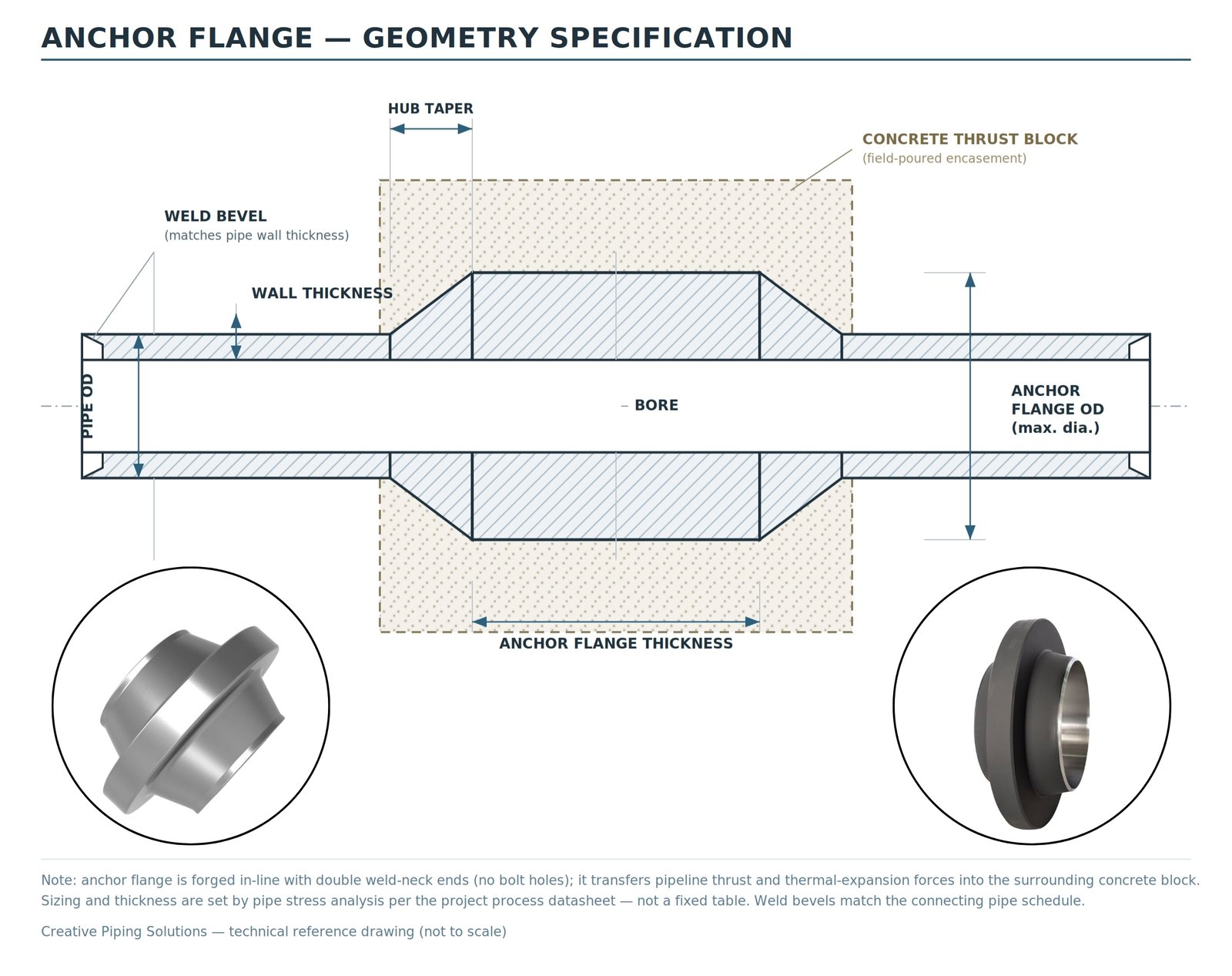
Pipe doesn't just sit still. Internal pressure pushes against every bend and dead end, temperature swings make it expand and contract, and buried lines shift with the ground around them. An anchor flange is a circular plate welded onto the outside of a pipe, then embedded in concrete or bolted to a structural support — converting a length of pipe that wants to move into one that's held firmly in place. Unlike a bolted flange, it isn't there to connect two pipe sections; it transfers axial and lateral load from the pipe into a fixed structure.
Creative Piping Solutions Pvt. Ltd. (Creativeforged.com) is a manufacturer and supplier of Pad Flanges and Anchor Flanges, serving customers across the United States, Middle East, Asia, Sri Lanka, Singapore, Nepal, Bhutan, Myanmar, Bangladesh, Italy, Ukraine, the United Kingdom, and Europe. With international export experience, we supply engineered flanges for piping, industrial, oil & gas, petrochemical, power, and infrastructure applications, manufactured to applicable international standards and customer specifications.
Why Anchoring Matters
A few forces make anchoring necessary on most pressure piping systems:
- Pressure thrust at bends, tees, and dead ends, where internal pressure pushes outward and tries to displace the fitting
- Thermal expansion and contraction, which moves pipe lengthwise on long straight runs
- Buried pipeline movement, where soil settlement or backfill pressure can shift a line if it isn't anchored at key points
- Expansion joints, which rely on a fixed anchor point on either side so the joint absorbs movement instead of the whole line shifting
Without adequate anchoring, these forces get transferred to whatever's downstream — a valve, equipment, or a weaker section of pipe — and that's usually where failure starts.
- Material
- Matched to the pipe material and grade — carbon steel, stainless steel, or alloy — for compatible welding and corrosion behavior
- Plate Diameter & Thickness
- Sized to the calculated thrust or axial load, pipe diameter, and embedment or bolting method
- Applications
- Buried pipeline wall penetrations, expansion joint anchor points, elevated pipe rack supports, and any point needing thrust or thermal-movement restraint
- Installation Method
- Cast into a concrete thrust block/wall penetration, or bolted to structural steel, depending on the project
- Load Consideration
- Sized by a load-transfer calculation, not a pressure-class lookup
Anchor Flange Installation Considerations
Anchor flanges are typically welded to the pipe with a full-penetration weld, since the joint carries real structural load rather than just containing pressure. Where the flange is embedded in concrete, adequate concrete cover and reinforcement around the embedment matter as much as the flange sizing — an undersized thrust block can fail even with a correctly sized anchor flange. Where it's bolted to structural steel, bolt sizing and spacing should be reviewed against the calculated load, not assumed from the pipe's pressure class.
Pad Flange vs. Anchor Flange vs. Standard Flange
These three get confused often enough that it's worth spelling out plainly, side by side:
| Component | Primary Job | Connects to Bolts? |
|---|---|---|
| Standard flange | Bolted joint between pipe/equipment | Yes |
| Pad flange | Reinforces shell around a nozzle | No — structural patch |
| Anchor flange | Restrains pipe movement/thrust | No — support & restraint |
A pad flange and an anchor flange can both appear on the same system, alongside standard bolted flanges — each doing a completely different job at a different point in the line.
Frequently Asked Questions
Do all nozzle openings need a pad flange?
No — only openings where the reinforcement calculation shows the nozzle neck thickness alone doesn't replace enough of the removed shell material.
What's the telltale hole for?
A small tapped hole on the pad's outer edge, left open during hydro testing. Escaping pressure signals a weld defect between the pad and shell that needs repair.
Is an anchor flange the same as a wall sleeve?
Related, but not identical. A wall sleeve typically allows a pipe to pass through a wall with some flexibility; an anchor flange locks the pipe in place and transfers load into the wall or thrust block.
How is an anchor flange sized?
By the actual axial and lateral forces at that point in the line — pressure thrust, thermal expansion, and any soil or seismic loading — rather than pressure class alone.
Can a pipeline need multiple anchor points?
Yes. Long runs with multiple bends, expansion joints, or elevation changes often need anchor points at several locations, each sized to local conditions.
Are pad flanges and anchor flanges the same as flange facings?
No. Facings (Raised Face, Flat Face, RTJ, and others) describe the gasket-sealing surface on a bolted connection. Pad and anchor flanges solve structural and support problems and aren't sealing components at all.
Need pad flanges or anchor flanges built to spec?
Creative Piping Solutions Private Limited is a reputed manufacturer of fittings and flanges, supplying pad flanges sized to your vessel's reinforcement calculation and anchor flanges built to your line's thrust and load requirements — with full material traceability, exported to the USA, the Middle East, and customers worldwide.