Beyond Raised Face: A Complete Guide to Flange Facing Types & Finishes
A flange facing is distinct from the flange type and pressure rating — and getting it wrong causes leaks, galling, or a joint that simply won't mate. Here's every facing type and finish used in industrial piping, with the specs you need to select the right one.
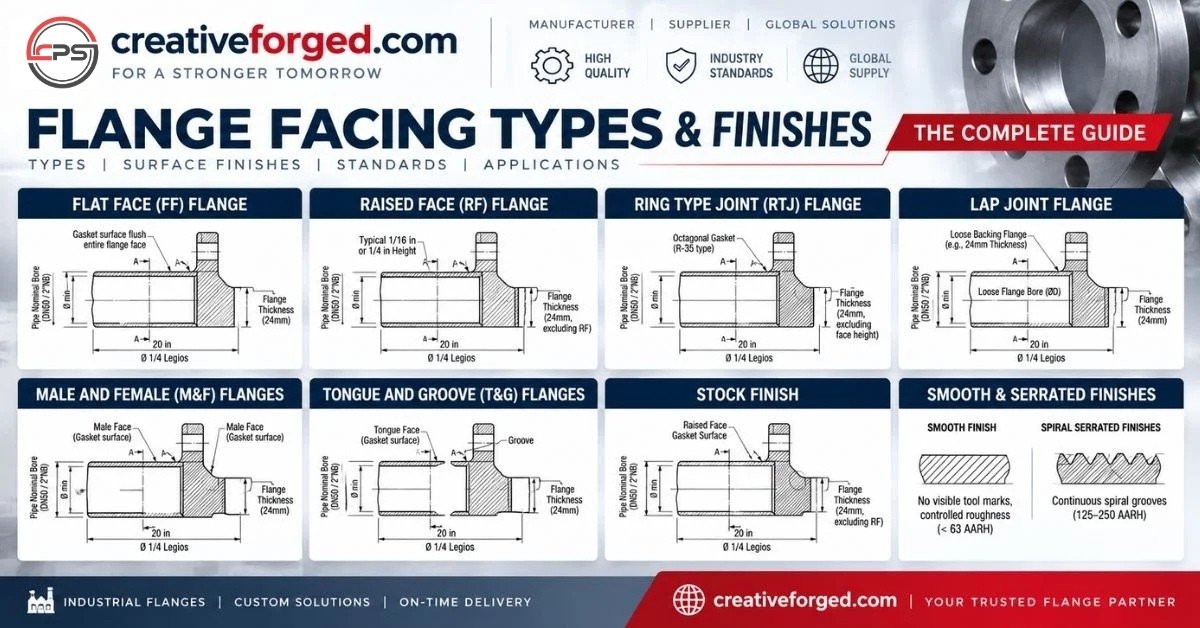
A flange facing is the machined surface where two flanges meet and compress a gasket to form a seal. This guide covers every facing type used in industrial piping — Flat Face, Raised Face, Ring Type Joint, Lap Joint, Male and Female, and Tongue and Groove — plus the surface finishes machined onto those facings: Stock, Smooth, Spiral Serrated, and Concentric Serrated. Each section includes the specs you need to select and specify correctly.
What Is a Flange Facing, and Why Does It Matter?
A flange facing is distinct from two other things buyers often confuse it with:
- Flange type (weld neck, slip-on, blind, socket weld, lap joint, threaded) — describes how the flange attaches to the pipe.
- Flange rating (Class 150–2500) — describes the pressure-temperature capability of the flange.
- Flange facing — describes the geometry and finish of the gasket contact surface itself.
The facing determines what gasket type you can use, how bolt load is distributed across the joint, whether the flange can mate with a given piece of equipment (pump, valve, vessel nozzle), and how forgiving the joint is to reassemble. ASME B16.5 and ASME B16.47 define standard facing dimensions by pressure class and nominal pipe size — always confirm against those tables for your specific size and class rather than relying on general figures alone.
Flat Face (FF)
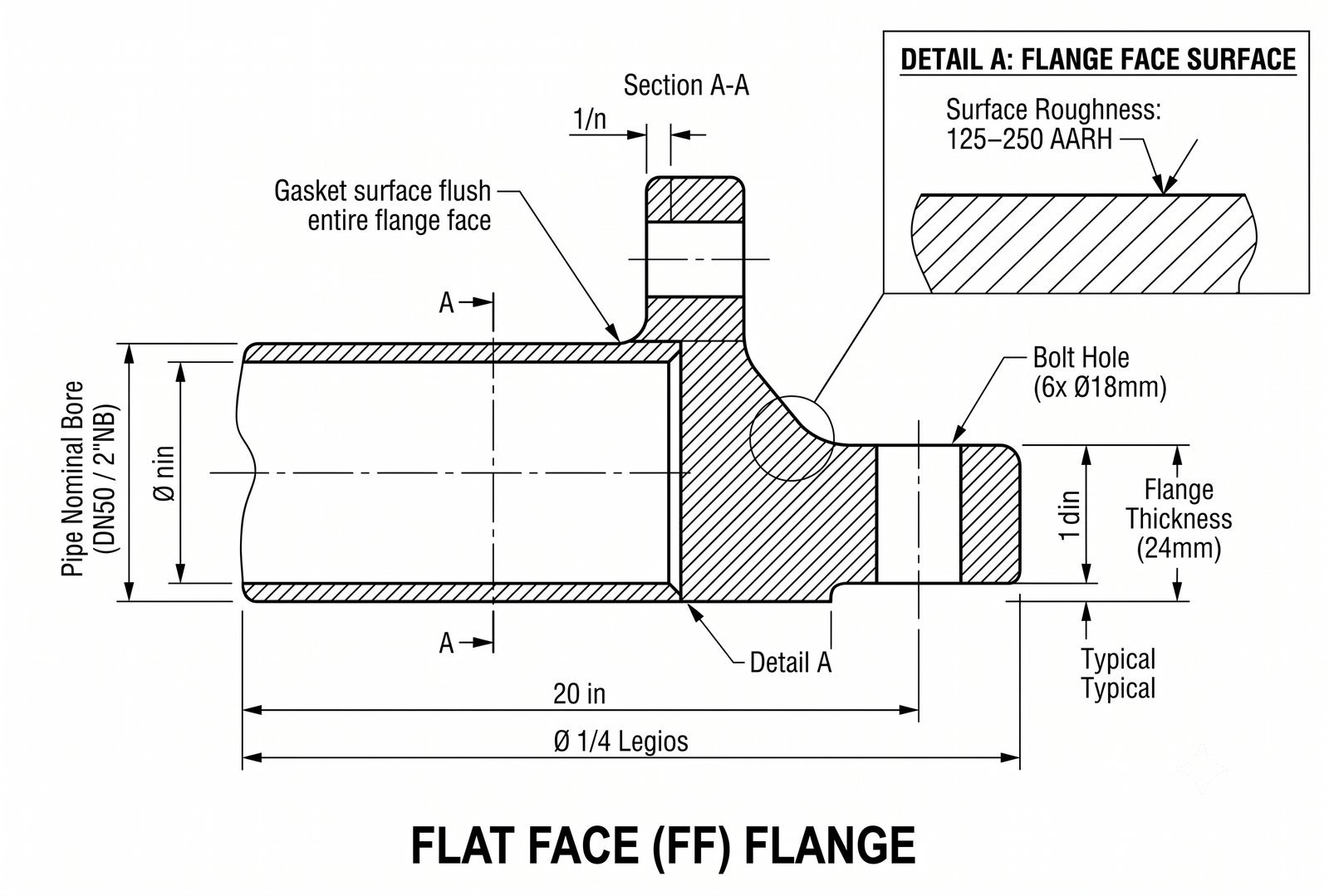
The gasket surface is machined flush with the bolt-circle face — there is no raised portion.
- Facing Height
- 0 in — flush with the bolt circle (no raised face)
- Surface Finish
- Smooth or lightly serrated, matched to gasket type
- Pressure Rating
- Typically Class 150–300; not commonly used at higher classes
- Temperature Range
- Set by the mating gasket and base material; commonly ambient-to-moderate service
- Applications
- Cast iron or brittle mating equipment (pumps, valves, tanks); low-pressure water, air, and non-hazardous fluid systems
- Standard
- ASME B16.5
- Gasket Type
- Full-face gaskets, covering the entire flange face including bolt holes
Raised Face (RF)
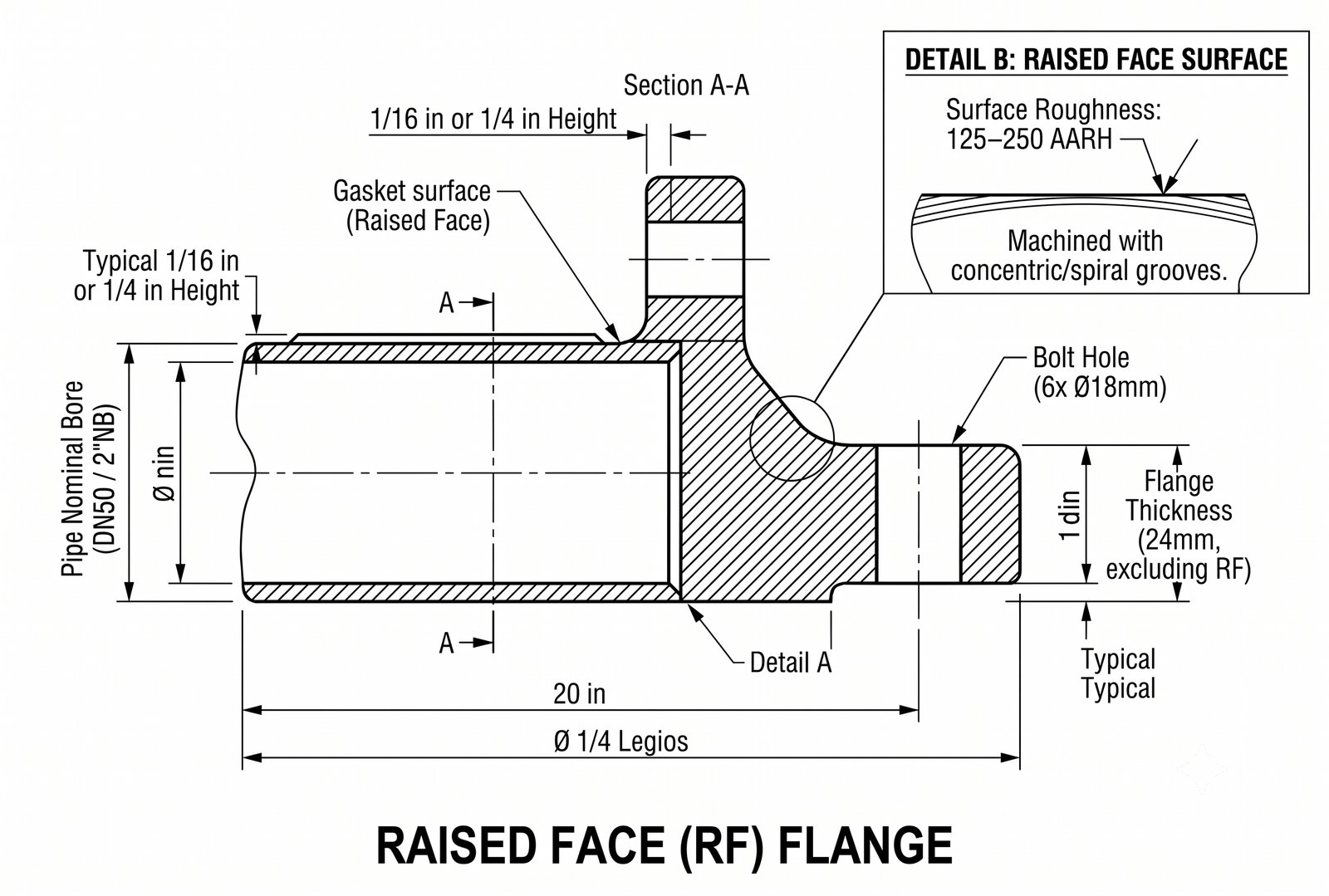
A raised portion machined above the bolt-circle face, concentrating gasket contact in a smaller area to increase unit pressure on the gasket and improve sealing.
- Facing Height
- 1/16 in (1.6 mm) for Class 150–300; 1/4 in (6.4 mm) for Class 400–2500, per ASME B16.5
- Surface Finish
- Concentric or spiral serrated, typically 125–250 µin Ra
- Pressure Rating
- Full range, Class 150–2500
- Temperature Range
- Cryogenic to high temperature — actual limit set by the gasket material (e.g. graphite-filled spiral wound, commonly rated to roughly 850°F / 450°C)
- Applications
- The default facing for general industrial piping — oil & gas, chemical processing, power, water/wastewater
- Standard
- ASME B16.5 / ASME B16.47
- Gasket Type
- Ring-type gaskets (spiral wound, solid metal ring, non-metallic ring) sized to the raised face diameter
Ring Type Joint (RTJ)
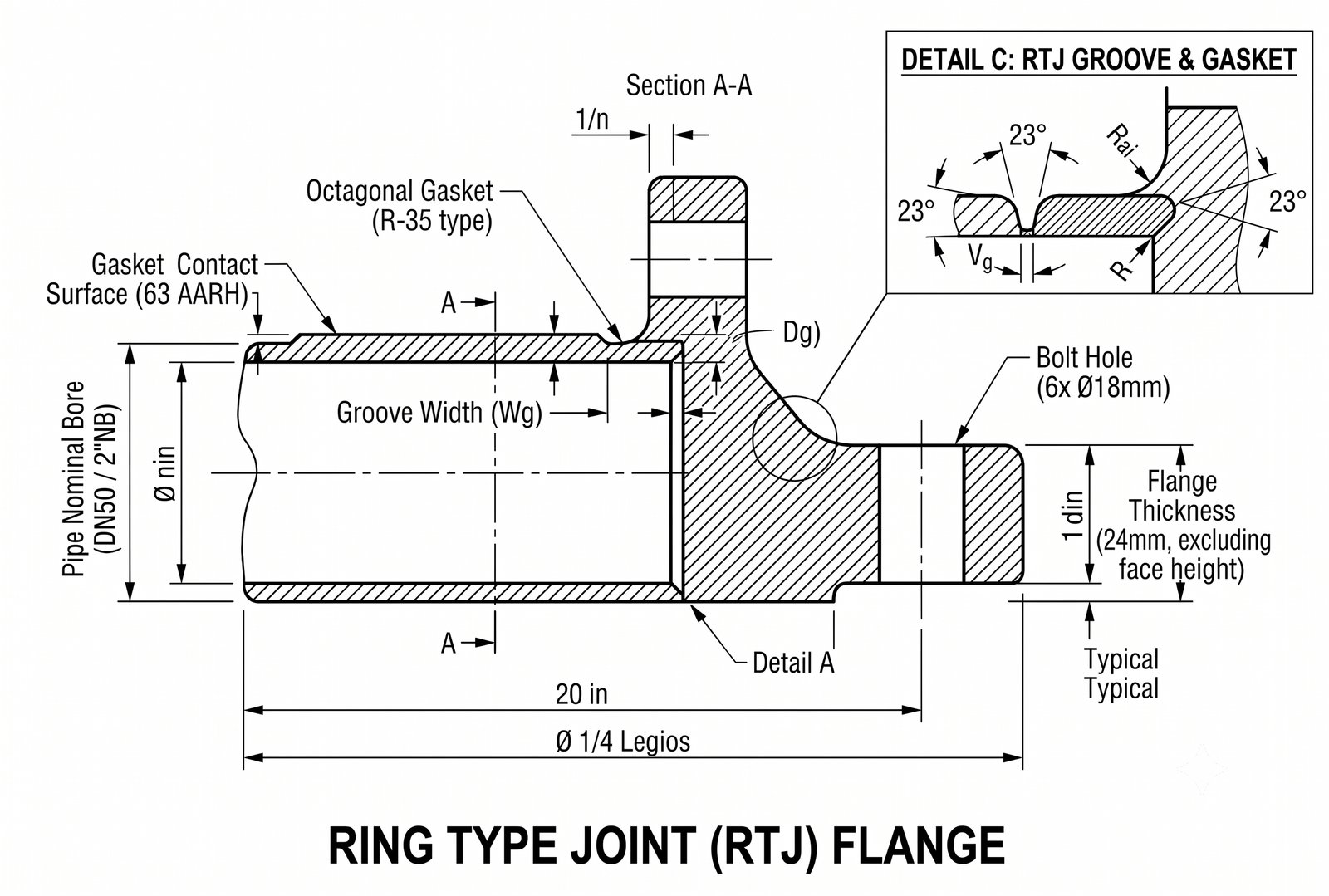
A precision-machined groove that houses a solid metal ring gasket. Compressing the ring into both flange grooves creates a metal-to-metal seal rather than relying on a soft gasket.
- Groove Profile
- Type R (oval and octagonal), and pressure-energized RX/BX profiles for higher pressure
- Surface Finish
- Precision-machined groove; no serration — the seal is metal-to-metal
- Pressure Rating
- Available Class 150–2500, most commonly specified at Class 600 and above
- Temperature Range
- Suited to the most demanding pressure/temperature service; actual limit set by the ring material (soft iron, low-carbon steel, stainless, or alloy)
- Applications
- Wellhead and production equipment, high-pressure valves, critical high-pressure/high-temperature piping
- Standard
- ASME B16.5 Appendix (dimensions), API 6A (wellhead/production equipment), ring numbers per ASME B16.20
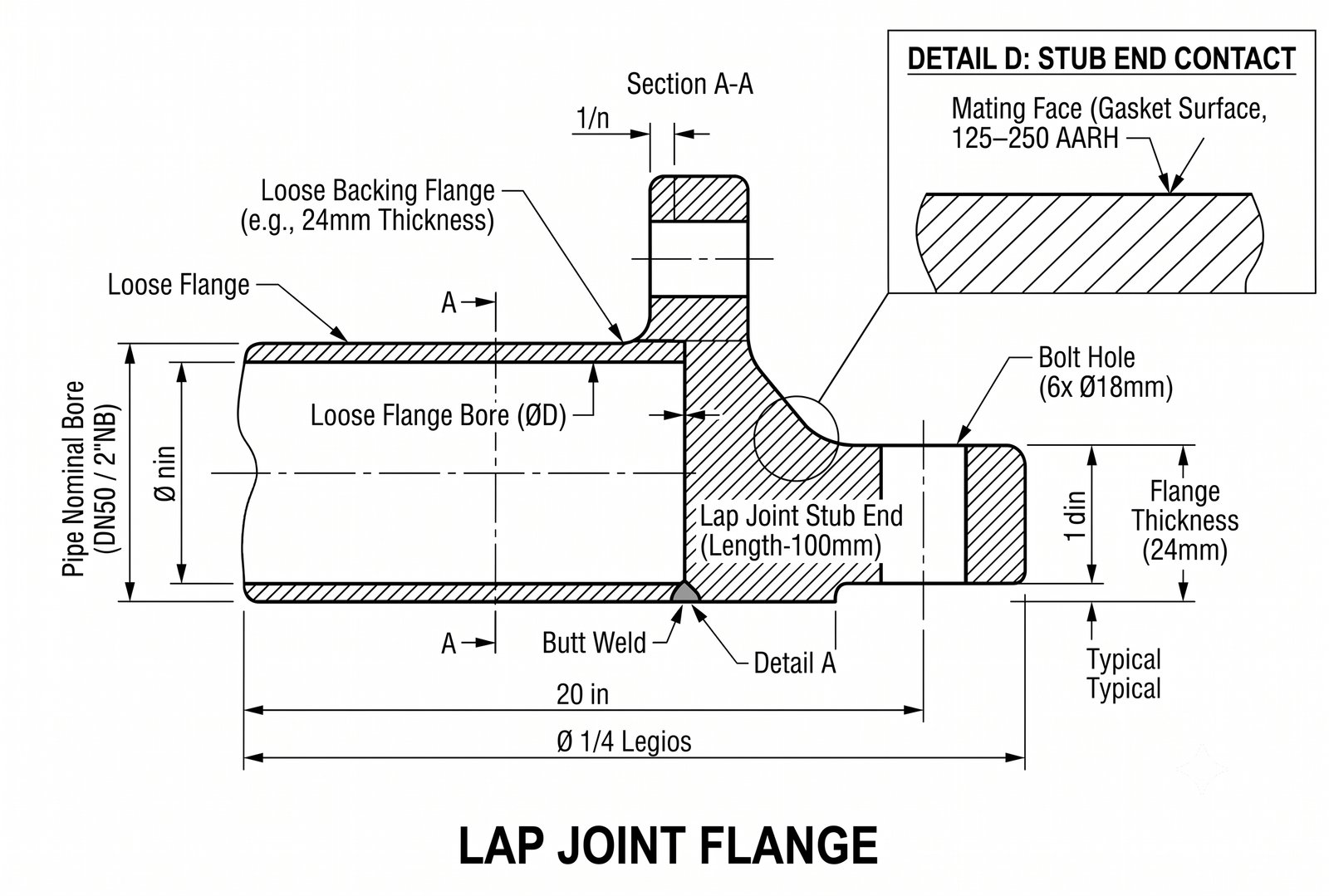
Lap Joint Facing
- Facing Height
- Matches whatever facing (FF or RF) is machined onto the stub end
- Surface Finish
- Matches the stub end facing — RF is most common
- Pressure Rating
- Same range as the stub end material and rating, Class 150–2500
- Temperature Range
- Dependent on stub end material selection
- Applications
- Alloy piping where minimizing expensive alloy material matters (only the stub end needs to be alloy); systems requiring frequent disassembly or precise bolt-hole alignment
- Standard
- ASME B16.5 (flange), ASME B16.9 (stub end)
Male and Female (M&F) Facing
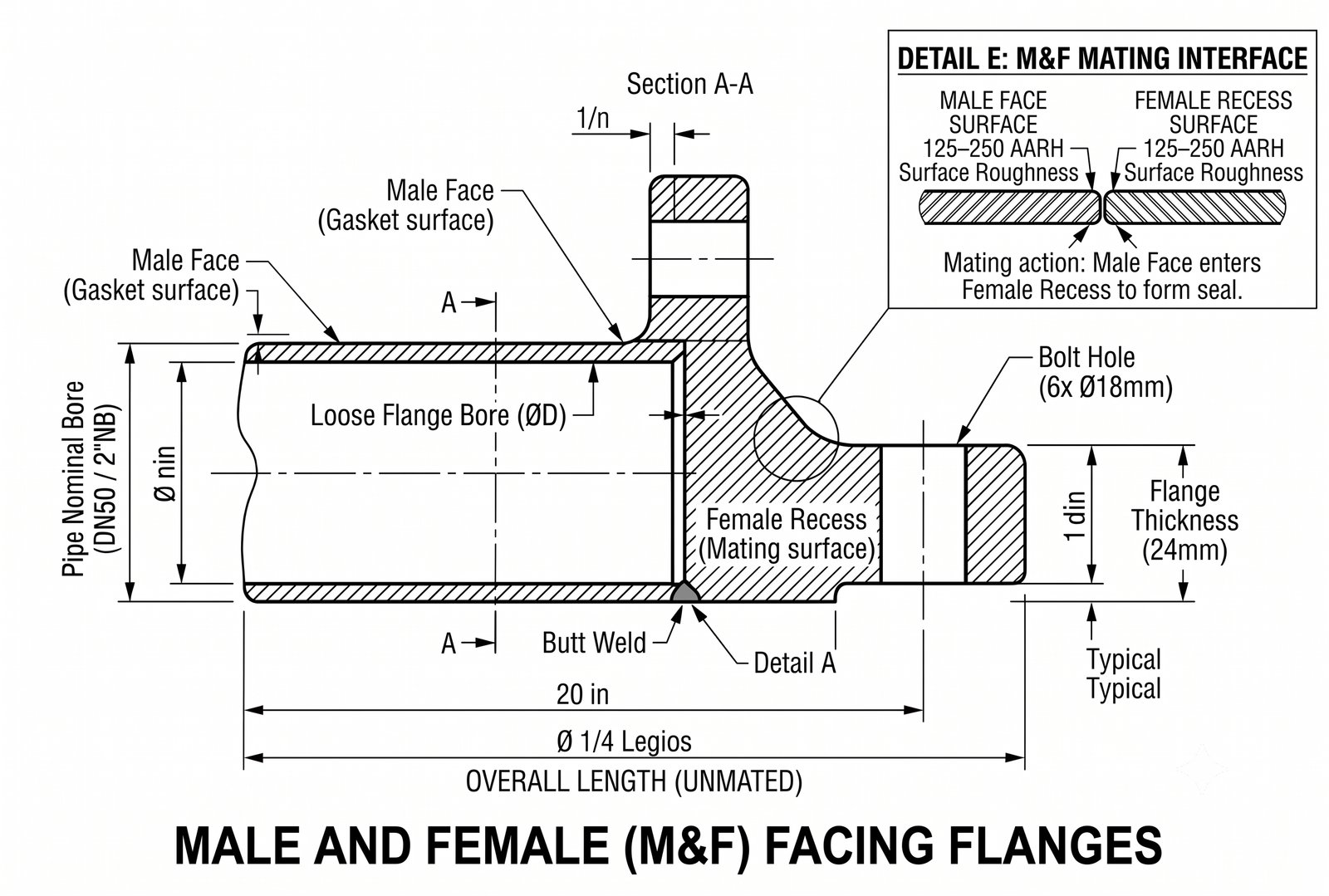
One flange face has a raised, machined male step; the mating flange has a matching recessed female step. The gasket sits inside the female recess, centered and partially confined by the male projection.
- Facing Height
- Male step raised above the face; female step recessed to match
- Surface Finish
- Smooth — the gasket seats directly in the machined recess
- Pressure Rating
- Typically Class 150–600
- Temperature Range
- Moderate service; limited primarily by the confined gasket material
- Applications
- Heat exchangers, and valve/vessel connections where positive gasket centering is required
- Standard
- ASME B16.5
Tongue and Groove (T&G) Facing
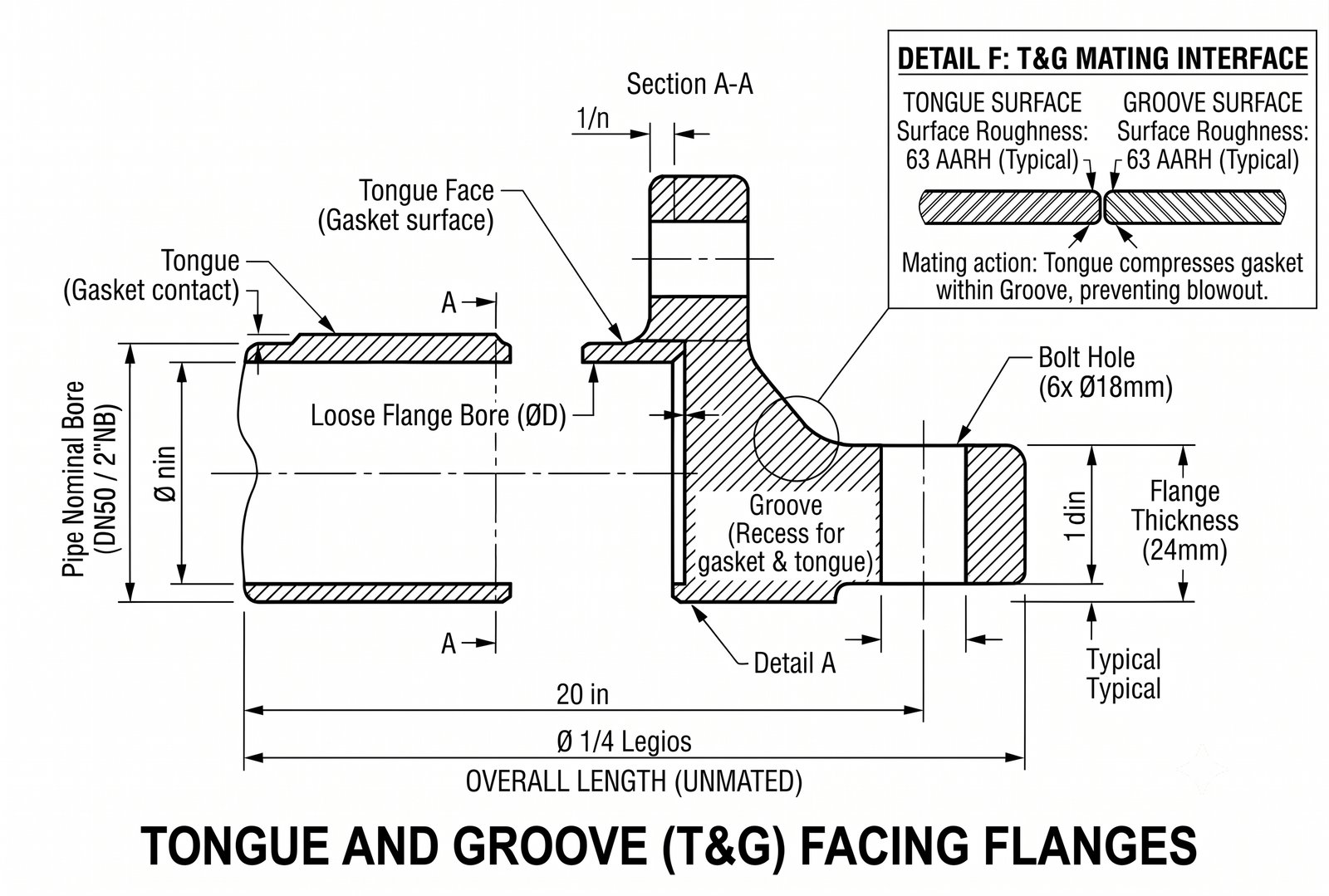
Similar concept to Male and Female, but with a narrower raised tongue fitting into a matching groove, fully confining the gasket on both its inner and outer edges — not just centering it.
- Facing Height
- Narrow raised tongue / matching machined groove
- Surface Finish
- Smooth — gasket is fully enclosed
- Pressure Rating
- Typically Class 150–900
- Temperature Range
- Moderate to high, gasket-material dependent
- Applications
- Heat exchangers, high-integrity sealing joints, and services where gasket blowout risk must be minimized
- Standard
- ASME B16.5
Facing Finishes: Stock, Smooth, Spiral Serrated & Concentric Serrated
Facing type (FF, RF, RTJ, etc.) describes the shape of the sealing surface. Facing finish describes the texture machined into that surface — a separate spec that affects gasket grip and seal integrity just as much as the facing type does.
Stock Finish
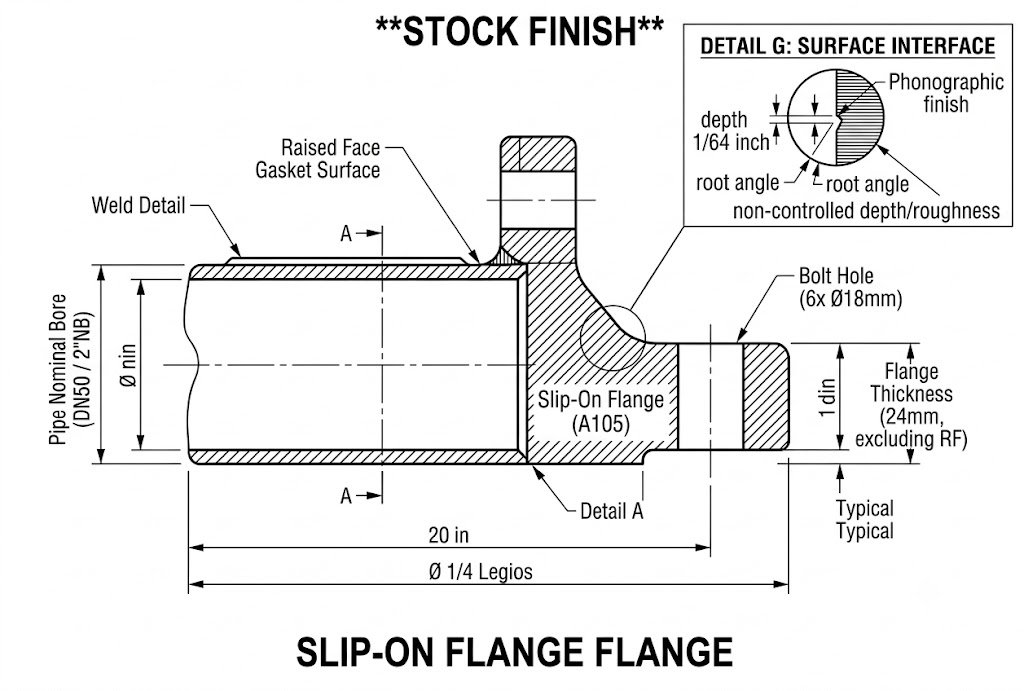
The standard finish supplied by default when no special finish is called out — typically concentric serrations at 125–250 µin Ra per ASME B16.5.
Applications: general-purpose gasketed joints; the most commonly supplied finish across industrial piping unless a project spec calls for something else.
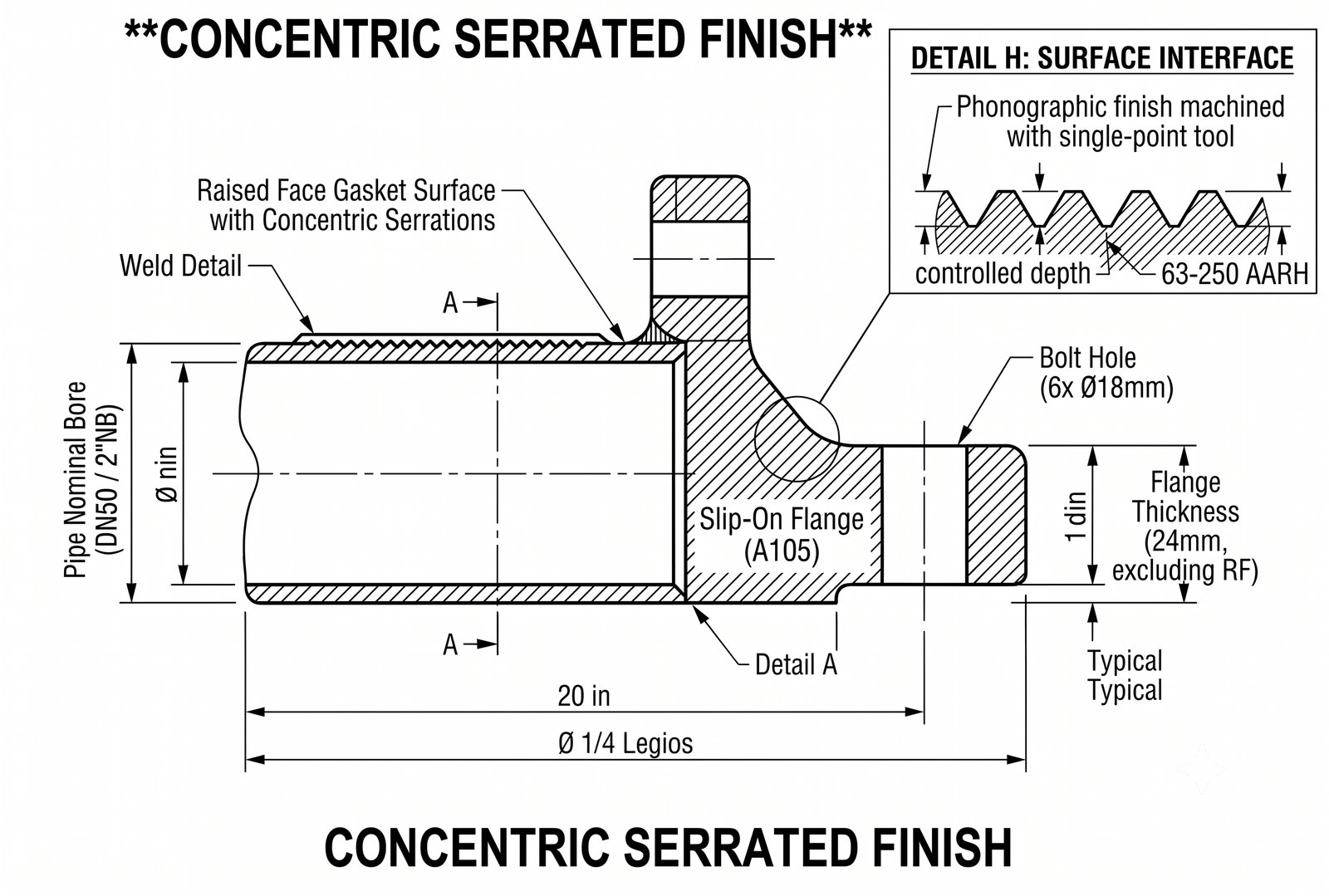
Concentric Serrated Finish
Concentric circular grooves machined as separate, closed rings across the facing — the most common serration pattern and effectively synonymous with "stock finish" on most flanges.
Applications: standard gasket-grip finish for spiral-wound and solid ring gaskets across most industrial piping.
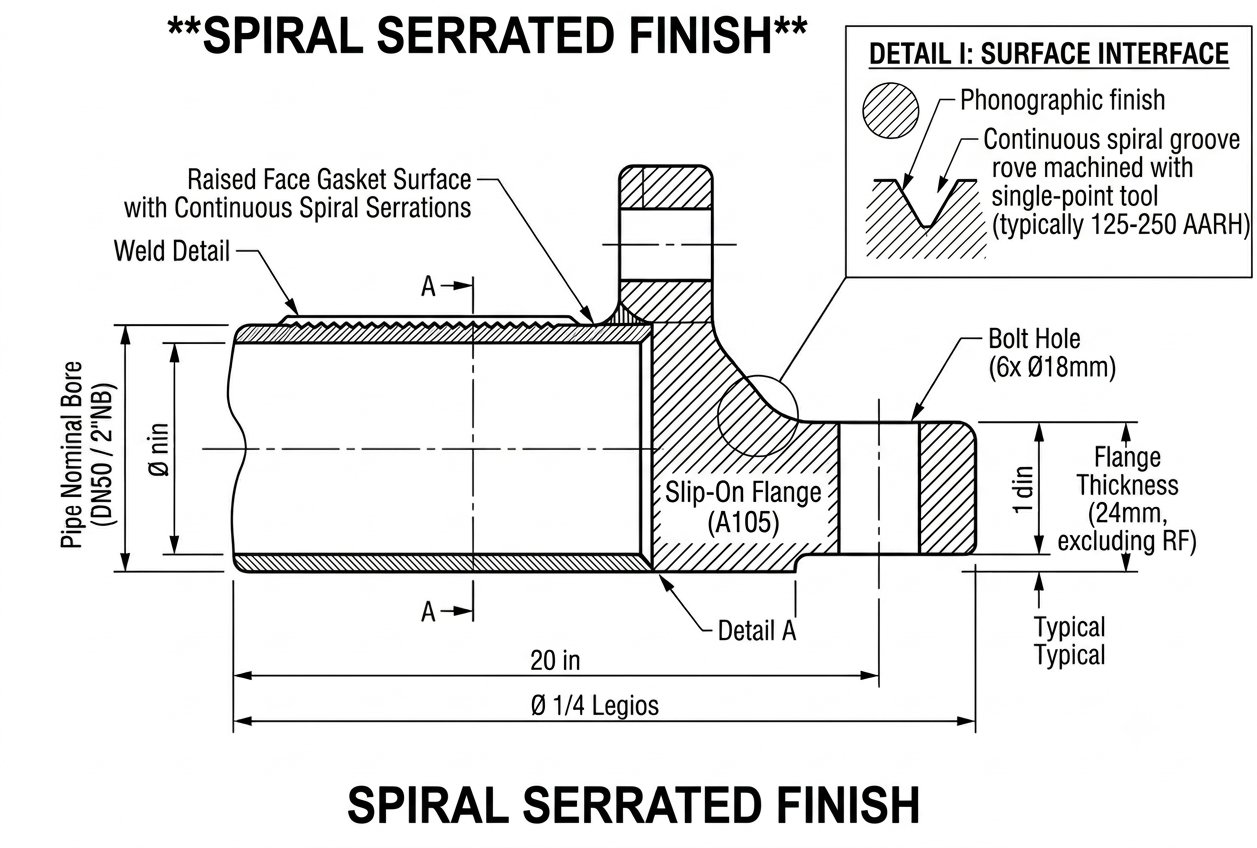
Spiral Serrated Finish
A single continuous spiral groove machined from the center of the facing outward, rather than separate concentric rings.
Applications: used with softer gaskets; the continuous groove path is sometimes preferred for its uninterrupted sealing surface.
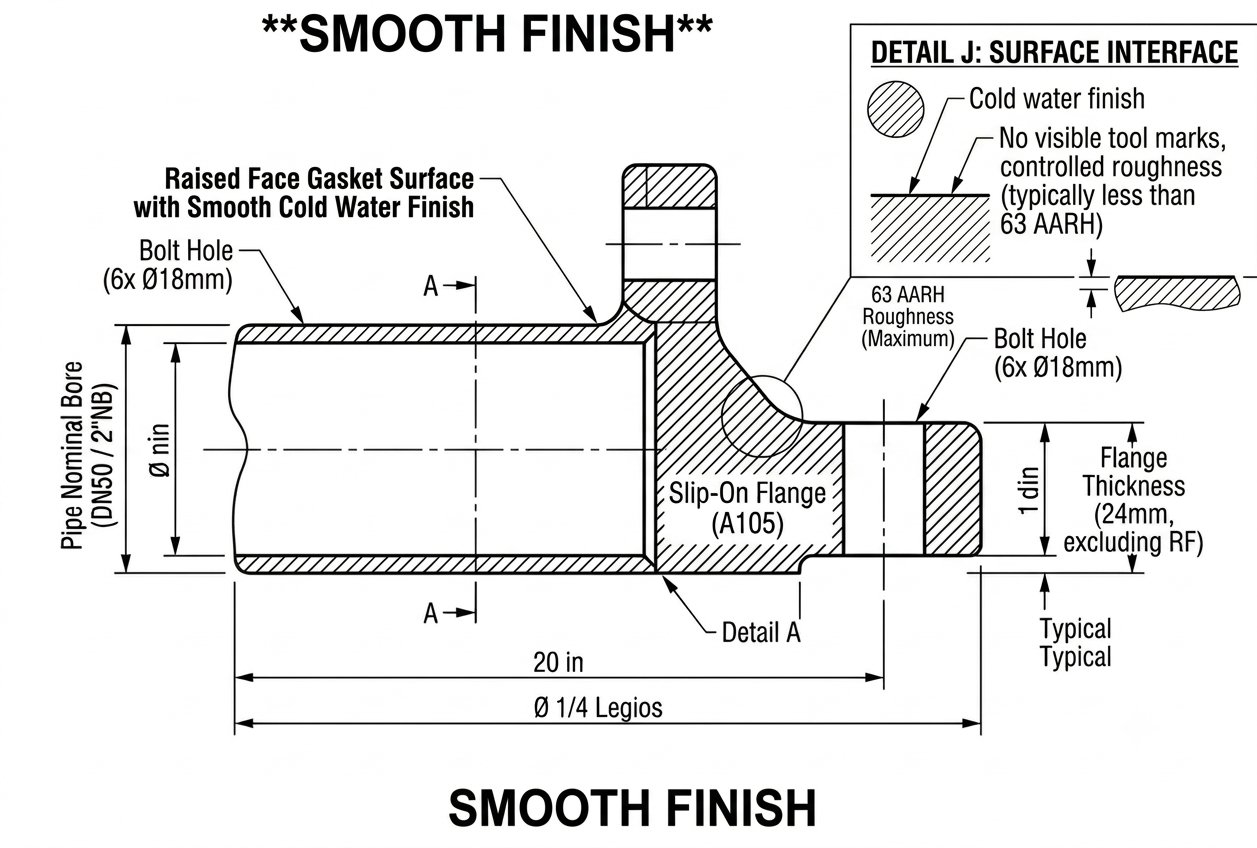
Smooth Finish
A finer, typically non-serrated surface (commonly 32–63 µin Ra or smoother) rather than the standard serrated pattern.
Applications: PTFE-faced, rubber-lined, or other soft/elastomeric gaskets that seal effectively without serration — and can be damaged or extruded by a standard serrated finish.
Facing Types & Finishes at a Glance
| Facing Type | Seal Method | Typical Pressure Range | Matched Pair? |
|---|---|---|---|
| Flat Face (FF) | Full-face soft gasket | Class 150–300 | No |
| Raised Face (RF) | Ring gasket | Class 150–2500 | No |
| RTJ | Metal ring gasket | Class 600–2500 (typical) | No |
| Lap Joint facing | FF/RF on stub end | Class 150–2500 | No |
| Male & Female | Confined soft gasket | Class 150–600 | Yes |
| Tongue & Groove | Fully confined gasket | Class 150–900 | Yes |
| Finish | Surface Texture | Best Suited To |
|---|---|---|
| Stock / Concentric | Concentric serrated rings | General-purpose, most gaskets |
| Spiral Serrated | Continuous spiral groove | Softer gaskets, continuous seal path |
| Smooth | Fine or unserrated finish | PTFE, rubber-lined, soft gaskets |
How to Choose the Right Flange Facing
- Match the mating equipment first. If you're bolting to a pump, valve, or vessel nozzle, its facing overrides most other preferences — FF must meet FF, M&F and T&G must meet their matched half.
- Size for pressure and temperature. RTJ for the most demanding service; RF for general industrial duty; FF for low-pressure or brittle mating equipment.
- Consider gasket blowout risk. Choose T&G or M&F where positive gasket confinement is critical.
- Match the finish to the gasket. Serrated (stock/concentric/spiral) for spiral-wound and ring gaskets; smooth for PTFE or soft elastomeric gaskets.
- Weigh cost and lead time. RTJ grooves cost more to machine and re-face than RF or FF facings.
- Always verify against the standard. Confirm facing height, diameter, and finish against ASME B16.5, B16.47, or API 6A for your exact size and pressure class before finalizing a spec.
Frequently Asked Questions
Can I bolt a raised face flange to a flat face flange?
Not without engineering review. The raised face concentrates bolt load onto a smaller area of the flat mating face, which can overstress or crack brittle materials like cast iron. Standard practice is FF-to-FF and RF-to-RF.
What gasket type is used with RTJ facings?
A solid metal ring gasket (oval or octagonal profile, or pressure-energized RX/BX types), not a soft or spiral-wound gasket. The ring compresses into the grooves on both flanges to form a metal-to-metal seal.
Is Lap Joint a facing or a flange type?
It's a flange type. The actual sealing facing (Flat Face or Raised Face) is machined onto the separate stub end that the lap joint flange rotates against, not onto the loose flange itself.
Are Male-Female and Tongue-and-Groove flanges interchangeable?
No. Both are directional facings that must be ordered and installed as matched pairs — a male face only mates with a female face, and a tongue only mates with its matching groove.
What's the difference between spiral serrated and concentric serrated finish?
Concentric serrated cuts separate closed rings into the facing; spiral serrated cuts one continuous spiral groove from center to edge. Both serve the same gasket-grip purpose and are common default ("stock") finishes.
Do I need a smooth finish for PTFE gaskets?
Often, yes. PTFE and other soft/elastomeric gaskets can seal effectively without serration, and a standard serrated finish can sometimes damage or extrude a soft gasket under bolt load — a smooth finish is frequently specified for these cases.
Which facing is most common in general industrial piping?
Raised Face (RF) with a stock/concentric serrated finish is the default across most Class 150–2500 industrial piping systems in the USA.
Need flanges in a specific facing and finish?
We manufacture FF, RF, RTJ, Lap Joint, M&F and T&G facings with stock, smooth, spiral and concentric serrated finishes, across A105, A350 LF2, A694, stainless and duplex grades.